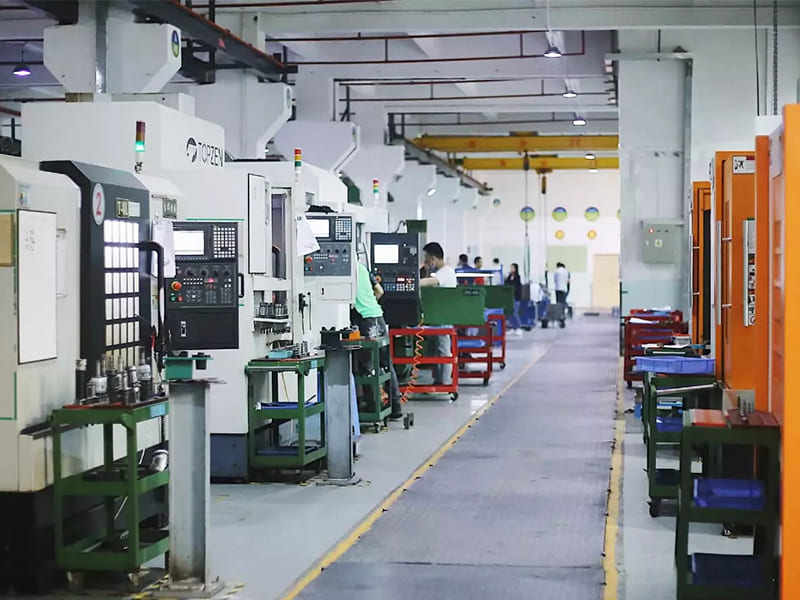
CNC turning is a typical subtractive manufacturing method that uses cutting tools to remove material from the outside of the material. As the workpiece rotates (keeps turning), excess material is shaved off until the end product is the right form, diameter, and size. CNC turning can cut through metal, wood, plastic, and other types of materials. Also, because the process uses computer-made programs and codes, the goods tend to be very accurate in terms of their sizes.
Turning involves spinning and turning a piece of work, which is usually a cylindrical or round piece of material. But when the right tools are used, turning can be done on materials with different shapes. On the spindle of a CNC lathe or turning center, there are many different tools that can be used. The more tools a machine can hold, the more complicated it is and the better it is at making complicated shapes.
1. Types of CNC turning operations
-
Linear turning
In linear turning, cutting tools are used to decrease the diameter of a workpiece in a uniform way. With this technology, things can be made to a certain thickness. It quickly takes away some of the material and keeps the diameter of the result from changing. It is sometimes called “rough turning,” and it needs more work to get accurate measurements.
-
Knurl processing
During this step, a rough, angled, or crisscrossing pattern of cuts is made on the surface of the item. Most of the time, the process makes the grip firmer because the design increases friction. It can also be used to make bolts and nuts for holes with threads. It’s important to note that knurling tools may be needed for this process.
- Split
Splitting is a type of machining in which a single-point cutting tool is used to make a deep hole in a piece of material and remove its inner parts. As the name suggests, it leads to parts being made or a piece of the original being cut off.
- Taper turning
In taper turning, the diameter of the object gets smaller and smaller from one end to the other. When the material and the tool that cuts it move at an angle, the width of the workpiece changes and gets smaller. As is the case with most spinning jobs, the end result is a cylinder.
- Threading
Threading is another type of CNC turning that involves moving the cutting tool along the side of the material to cut threads into the parts of the item that are visible from the outside. Threads are spiral lines that are a certain size and distance apart.
-
Grooving
With this process, a narrow groove is cut into the workpiece. It’s done by a sharp tip cutting through the material at the same width as the cutting tool. Different cutting tools can be used to make grooves with a bigger diameter.
2. Materials suitable for CNC turning processing
One of the best things about CNC cutting is that it can work with a lot of different materials. In the same way, most metals and plastics are good for CNC turning:
·Aluminum
·Nylon
·Copper
·Steel
·Wood
·Titanium alloy
·PEEK
·ABS
·Glass
·PVC
·Brass
·Wax etc.
Because each material has different structural integrity, it may require unique specifications for different lathes or turning centers, such as feed rates and turning speeds.
3. Types of CNC lathes
In fact, most tools used for turning are called lathes. But these tools come in different kinds, and each is better for a certain kind of turning. There are four different kinds of CNC lathes that you can use for your projects.
·Horizontal CNC lathe
These lathes have all the features of a normal lathe, which makes them one of the most common machines used in many industries. But they are better for tasks like turning and boring.
·Vertical CNC lathe
The biggest difference between it and a horizontal lathe is how it holds the workpiece. Before the material is rotated and cut, it is set up upright, starting from the bottom. So, these tools work best in places where there isn’t much room.
·Horizontal turning center
Horizontal turning centers are sealed pieces of machinery that can drill and mill. As the name suggests, a turning center is set up so that the tool is horizontal. As the tool slowly rotates and cuts into the object, gravity fills in the cut.
·Vertical turning center
As a horizontal turning center and CNC mill in one, its design keeps the rotating chuck close to the ground, making it easier to work with big pieces.
4. Different components of a lathe
Although there are different lathes, they all actually have similar parts. So, let’s take a brief look at the components of a typical lathe.
- CNC panel
The screen is kind of like the machine’s brain. It means the room where computer programs and code are put in by mechanics and techs. On the CNC panel, there is a set of keys that can be used to start the machine, enter a new program, or stop a project.
- Spindle
The head frame is built around the shaft. It is the part of a machine that turns and has an axis. Also, it’s not unusual for the tailstock to have a wheel as well.
- Head frame
The headstock holds the rest of the lathe together like a clamp. Among other machine parts, it has gears, spindles, chucks, and control rods.
- Tailstock
The tailstock is at the other end of the neck. It is a stationary center that can do boring work.
- Lathe bed
The bed is the most important part of a lathe because all the other parts, like the headstock, chuck, tailstock, etc., are connected to it. It is also a large horizontal frame that can be made even bigger to fit large pieces of work.
- Chuck
Another important part of the lathe is the chuck. It helps clamp (grasp) the object so that it can be worked on.
- Frame
Between the headstock and the tailstock is the frame, which has parts like saddles, cross plates, and fenders. It guides the tool that is used to cut the outside of the workpiece.
- Cutting tools
Cutting tools have tool heads that break off pieces of the material as the tool is turned. Usually, the process of cutting and turning depends on the type of cutting tools that are in the machine.
- Tool turret
The lathe’s tool holder is the tool turret. The number of knives that a standard turret can hold is based on its size and shape.
- Foot pedal
The foot pedal facilitates quick opening and closing of the tailstock or chuck.
5. Common Types of Turning Tools
Different turning operations are suitable for different lathe cutting tools:
-
Facing or turning tools
With these lathes, you can cut flat surfaces at right angles to the material’s line of rotation. During machining, the cutting tool is held in place by the tool holder on the carriage, which then cuts perpendicular to the line of rotation.
-
Thread cutter
This cutting tool can be used to cut things from both the outside and the inside. As the name implies, they are also great tools for cutting threads on a lathe.
-
Boring bar
Boring bars are not really tools for turning. Instead, they are single-pointed tools that can be used to bore holes in the workpiece. These tools basically make a hole bigger by making it wider.
-
Grooving tools
Grooving tools can be used to cut features like holes and O-rings into pieces of work. Also, they are great for making curves in the material, which lets the necks of different pieces of work fit well with each other.
-
Knurling Tool
The shapes and patterns on these turning tools help them grip the workpiece better. When pressed into the material, they leave their knurled design. So, they can be used to make handles, bolts, nuts, and other parts for tools.
6. Application of CNC turning
- Automotive industry
CNC turning is a fairly common process used to make parts for cars. It can be used to make metal parts like engine blocks and plastic parts, as well as parts for the instrument panel.
- Electrical industry
CNC lathes can be used to make circuit boards and other types of electrical parts. The product is electronically valid and meets all requirements and standards because the machining process is very precise.
- Aviation industry
Due to the high accuracy of its measurements, the aircraft industry needs to use CNC lathes and machining. They can be used to create steel parts for the space shuttle, fasteners for airplanes, and interior parts.
Frequently Asked Questions
1. What is the processing axis of the lathe?
CNC lathes may come in different configurations, best defined by the movement of the axes. They include the following.
- 2-Axis: Typical lathe; X and Y axes.
- 3-Axis: The rotary drill bit runs along the X, Y and Z axes.
- 4-Axis: Contains two common axes and additional Y-axis and A-axis.
- 5-Axis: Movement across five directions. X, Y, Z and A, B axes.
- Multi-axis: An automatic sliding lathe may have more than nine different axes.
2. What is the difference between turning and milling?
Turning involves the rotation of a workpiece against a non-rotating, single-point cutting tool, while milling uses a rotating tool to remove parts of a stationary workpiece. Additionally, the turned product is usually cylindrical or conical, while the milled end product is flat.
3. What are the three main movements in turning operations?
During the turning process, the following movements occur:
- Rotation: In the turning process, the workpiece is constantly rotating and turning during the cutting process.
- Advanced motion: The tool performs linear motion on the material in a parallel configuration, enabling machining.
- Penetration: The tool cuts fragments of material as it penetrates, which may determine the depth of the cut.
About the Author: Gavin Xia